

Parking Lot Pothole Repair: What Causes It and How Fast It Should Be Fixed

A pothole in a commercial parking lot rarely appears overnight without warning. In most cases, it is the result of pavement deterioration that has been developing beneath or across the surface for months—or even years.
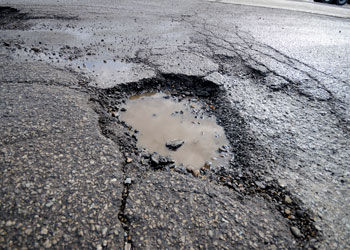
A small crack allows water to penetrate the asphalt. The base underneath becomes weaker. Iowa's repeated freezing and thawing puts additional stress on the pavement. Vehicles continue driving across the weakened area until pieces of asphalt begin breaking loose. Eventually, what started as a relatively small pavement problem becomes a pothole.
For business owners, property managers, churches, schools, apartment communities, industrial facilities, and municipalities, the question should not simply be, "How do we patch this pothole?"
The better questions are:
Why did the pothole form, how quickly should it be repaired, and is there an underlying problem that needs to be addressed?
At Pate Asphalt, we have more than 40 years of experience in asphalt and blacktop paving. Our experience spans well over 250,000 projects—from large commercial properties and neighborhood-scale paving to mile-long residential driveways and traditional residential projects. Pate Asphalt's current website confirms more than four decades serving Eastern Iowa and expertise across residential, commercial, and industrial asphalt paving.
Here is what property owners need to know about parking lot pothole repair, what causes parking lot potholes, and why waiting too long can create a much larger problem.
What Actually Causes Parking Lot Potholes?
A pothole is often the visible symptom of a problem happening underneath the pavement.
Asphalt is designed to support vehicle traffic, but its performance depends heavily on the condition of the pavement structure and the base below it.
One of the most common sequences begins with cracking.
Small cracks develop from age, traffic, temperature changes, pavement movement, or other stresses. When those cracks remain open, rain and melting snow can move beneath the asphalt.
Once moisture reaches the base, the supporting material can begin to weaken.
During an Eastern Iowa winter, that moisture can freeze and expand. When temperatures rise, it thaws again. Repeated freeze-thaw cycles put additional stress on already weakened pavement.
Then traffic does the rest.
Cars, delivery trucks, garbage trucks, semis, snowplows, and other vehicles repeatedly pass over the compromised area. Eventually, asphalt begins breaking apart and material is displaced.
The result is the familiar depression or hole we call a pothole.
Pate Asphalt's existing parking lot guidance identifies cracks, potholes, drainage problems, and pavement deterioration as signs that commercial asphalt needs attention.
Water Is Often the Bigger Problem
After four decades working with asphalt in Iowa, one lesson continues to matter:
Water has to be managed.
Property owners sometimes see a pothole and assume the solution is simply to fill the hole.
Sometimes that is appropriate.
Other times, the pothole is telling us that water is entering the pavement system from somewhere else.
Look around the damaged area.
Is water pooling nearby after rain?
Is there a low spot?
Are cracks surrounding the pothole?
Is runoff moving toward the damaged pavement?
Has the same pothole been repaired more than once?
If a parking lot pothole repeatedly returns in the same location, simply filling the top may not address the underlying reason for the failure.
Drainage, base instability, widespread cracking, or structural deterioration may need to be evaluated.
How Fast Should Parking Lot Potholes Be Fixed?
Our recommendation is straightforward:
Do not ignore an active pothole.
How urgently it needs repair depends on its location, depth, size, traffic exposure, and the condition of the surrounding pavement.
A small pothole in a low-traffic corner of a large parking lot does not necessarily create the same immediate concern as a deep pothole directly in front of a store entrance.
Some situations should be treated as priorities.
Potholes in Main Traffic Lanes
If vehicles are repeatedly hitting the pothole while entering, exiting, or moving through the property, it should be evaluated quickly.
Repeated traffic can enlarge the damaged area and dislodge additional asphalt.
Potholes Near Pedestrian Areas
A pothole near a sidewalk transition, storefront, crosswalk, or commonly traveled pedestrian route deserves prompt attention.
Commercial parking lots serve people as well as vehicles.
Potholes Near Entrances and Exits
Your entrance is one of the highest-use portions of the property.
When pavement begins failing near an entrance, customers, employees, delivery drivers, and vendors may drive across the damaged area throughout the day.
Deep or Rapidly Growing Potholes
If a pothole appears to be getting larger, do not assume it will stabilize.
Continued moisture and traffic can cause deterioration to spread beyond the original hole.
The faster the cause is identified, the more options a property owner may have for addressing the problem before it becomes a larger pavement failure.
Why Waiting Can Make Parking Lot Pothole Repair More Complicated
One reason we encourage customers to address pavement problems early is that asphalt deterioration tends to progress.
A pothole creates an opening where additional moisture can enter.
Traffic can break away the edges.
The surrounding asphalt may begin cracking.
The underlying base can become increasingly exposed.
What may begin as an isolated repair can eventually become a larger patch, resurfacing project, or—in severely deteriorated sections—reconstruction.
Pate Asphalt's Asphalt Safety Audit Checklist: How to Improve Lot Safety & Reduce Liability explains why property managers should regularly inspect pavement for cracks, potholes, settlement, drainage issues, and other surface conditions rather than waiting until problems become severe.
That article is an excellent companion to this guide because pothole repair should be part of a larger parking lot maintenance strategy.
Not Every Pothole Should Be Repaired the Same Way
This is where professional experience becomes important.
When someone searches for parking lot pothole repair, they may assume every repair consists of putting asphalt into a hole and compacting it.
Real pavement repair is more nuanced.
The correct method depends on:
The size and depth of the pothole
The strength of the surrounding asphalt
Whether the base has failed
Drainage conditions
Traffic volume
Vehicle weight
The age of the parking lot
The amount of surrounding cracking
Whether the problem is isolated or widespread
If the surrounding pavement is structurally sound, an isolated repair may make sense.
If the base underneath has failed, removing damaged material and repairing the underlying area may be necessary.
If potholes are appearing throughout an aging parking lot alongside extensive cracking and drainage issues, constantly patching individual holes may stop making financial sense.
At that point, resurfacing or more substantial reconstruction may need to be considered.
Pate Asphalt provides paving, resurfacing, patching, crack repair, sealcoating, and maintenance services for residential and commercial properties, allowing the repair strategy to be based on actual pavement conditions rather than forcing every property into the same solution.
Parking Lot Potholes Can Affect Your Business Image
There is another factor that commercial property owners sometimes overlook: appearance.
Your parking lot may be one of the first parts of your property a customer experiences.
Before someone sees your lobby, storefront, office, restaurant, church, medical facility, or apartment building, they may drive across your parking lot.
A clean, well-maintained paved surface sends a different message than a parking lot filled with potholes, standing water, fading lines, and broken pavement.
Parking lot maintenance is not only about asphalt.
It contributes to the overall experience people have with the property.
For retail centers, restaurants, offices, banks, churches, schools, manufacturing facilities, and property-management companies, maintaining the parking lot is part of maintaining the property itself.
Heavy Traffic Can Accelerate Pothole Damage
Not every parking lot experiences the same loads.
A small professional office may primarily accommodate passenger vehicles.
A retail property may see hundreds or thousands of vehicle movements.
A warehouse may regularly handle delivery trucks.
A manufacturing property might support semis, forklifts, trailers, or heavy service vehicles.
Those differences matter.
If heavy vehicles repeatedly cross a weakened section of pavement, deterioration can progress faster.
This is why Pate Asphalt evaluates commercial paving differently from a typical residential driveway.
The pavement needs to fit the property's actual use.
Pate Asphalt serves commercial properties with asphalt installation, maintenance, and repair services designed for high vehicle and foot traffic.
Fix the Pothole—But Look for the Cause
If there is one idea property owners should take away from this article, it is this:
Do not treat every pothole as an isolated event.
Repairing the visible damage is important.
Understanding why it happened is even more valuable.
When evaluating a parking lot pothole, consider the surrounding pavement.
Are cracks feeding into it?
Does water collect nearby?
Are several potholes forming in the same traffic lane?
Are the edges of the pavement deteriorating?
Does the surface appear to be sinking?
Has the same area been repaired repeatedly?
Those clues can help determine whether the property needs a localized pothole repair or a larger pavement strategy.
Preventing the Next Pothole
The best pothole repair is the one you can avoid needing in the first place.
Routine parking lot inspections allow property owners to identify small problems before they become obvious failures. Crack sealing is particularly important because open cracks create pathways for moisture.
Drainage should also be monitored.
If water routinely stands on the pavement after storms, it is worth determining why.
Preventive maintenance such as crack repair, sealcoating when appropriate, drainage correction, localized repairs, and periodic professional inspections can help property owners get more value from their asphalt investment.
Pate Asphalt's existing commercial maintenance guidance likewise recommends regular inspections, crack treatment, and prompt repairs rather than allowing damage to spread.
More Than 40 Years of Asphalt Experience
Experience matters when deciding whether pavement should be patched, resurfaced, or replaced.
Pate Asphalt has served Eastern Iowa for more than 40 years, handling asphalt and blacktop projects of dramatically different sizes.
Our experience includes large commercial parking lots, business properties, neighborhood-scale paving, long rural and acreage driveways, residential driveways, and other asphalt applications.
That range matters because asphalt problems rarely exist in isolation.
A contractor needs to understand grading, drainage, base preparation, traffic, weather, pavement age, and long-term use.
Pate Asphalt's public website confirms that the company works across residential, commercial, and industrial paving and serves communities throughout Eastern Iowa, including Cedar Rapids, Iowa City, Waterloo, Cedar Falls, Dubuque, and the Quad Cities.
What a Pate Asphalt Customer Says
One of the best measures of a paving contractor is what customers say after the equipment leaves.
After Pate Asphalt resurfaced and repainted the parking lot at Cedar Hills Community Church, customer Rick Lyons explained that the company coordinated the project around the organization's daily activities:
"They worked with us to get the work done with minimum impact on our daily operation."
His testimonial also notes that Pate provided guidance about work that could be needed in future years, helping the organization anticipate future pavement expenses.
That forward-looking approach is especially valuable in commercial pavement management. Sometimes the smartest recommendation is not simply repairing today's problem—it is helping the owner understand what could come next.
Frequently Asked Questions About Parking Lot Pothole Repair
1. What causes potholes in asphalt parking lots?
Parking lot potholes commonly develop when cracks allow water into the pavement structure. Moisture, freeze-thaw cycles, traffic loads, weakened base material, drainage problems, and pavement deterioration can work together until asphalt begins breaking apart.
2. How quickly should a commercial parking lot pothole be repaired?
Potholes should be evaluated and addressed promptly, especially when they are deep, growing, located in heavily traveled lanes, or near entrances and pedestrian areas. Waiting can allow water and traffic to worsen the damaged section.
3. Can you repair a pothole without replacing the entire parking lot?
Yes. Many isolated potholes can be repaired without replacing an entire parking lot. However, if potholes are widespread or associated with extensive cracking, drainage failure, or base deterioration, resurfacing or reconstruction may be the better long-term approach.
4. How can businesses prevent parking lot potholes?
Regular pavement inspections, prompt crack repair, good drainage, preventive maintenance, and correcting localized failures before they spread can reduce the likelihood of severe pothole development. Pate Asphalt recommends monitoring pavement condition rather than waiting until deterioration becomes widespread.
Do You Have Potholes in Your Parking Lot?
One pothole may seem like a small maintenance issue.
But if you are seeing repeated parking lot potholes, growing cracks, standing water, settlement, or multiple damaged areas, your pavement may be telling you that something more is happening.
Finding the cause early can help you make a better decision.
Maybe the solution is a localized repair.
Maybe cracks need attention.
Maybe drainage needs to be addressed.
Maybe part of the lot needs resurfacing.
Or perhaps an older parking lot has reached the point where replacement makes more financial sense.
With more than 40 years of asphalt and blacktop paving experience and hands-on work ranging from residential driveways to large-scale commercial projects, Pate Asphalt can evaluate the condition of your pavement and recommend an appropriate solution.
Call for Your Residential or Commercial Project
Whether you need parking lot pothole repair, commercial asphalt repair, blacktop paving, resurfacing, crack repair, a new parking lot, or residential driveway paving, Pate Asphalt is ready to help.
Call Pate Asphalt at 319-393-4812 for your residential or commercial project.
From individual repairs to complete commercial paving projects, choose an Eastern Iowa asphalt contractor with more than four decades of experience.
Pate Asphalt — experienced asphalt and blacktop solutions for residential and commercial properties throughout Eastern Iowa.


Comments